
Profile

|
Konstantin Wilfried Kühlem, M.Sc. |
Publications
Listening Effort in Complex Audiovisual Scenes Under Varying Simulated Room Acoustic Conditions

Reverberation can degrade speech intelligibility and comprehension, increase cognitive load, and impair memory. Many studies examining reverberation effects use audio-only conditions and stationary background noise. Thus, it remains unclear to what extent findings generalise beyond laboratory setups. In the present study, we examine the influence of reverberation on memory and behavioural listening effort in a complex, audiovisual virtual reality (VR) environment. We implemented a virtual reality (VR) open-plan office with realistic room acoustics and time-varying background noise, including animated virtual agents. Three simulated room-acoustic conditions were compared: a free-field, an acoustically optimised office, and an untreated office. Under these conditions, N = 30 participants performed a dual-task. The primary Heard-Text Recall (HTR) task measured speech comprehension and memory. Participants listened to short stories narrated by two speakers and answered content-related questions. The vibrotactile secondary task measured listening effort. In single-tasking, memory for spoken content was significantly better in free-field than in both offices, with no significant difference between offices. In dual-tasking, vibrotactile response times indicated that listening effort increased in the presence of reverberation. Across single- and dual-task conditions, vibrotactile error rates decreased in the presence of reverberation, possibly due to elevated concentration in more difficult conditions. These findings suggest that room acoustics, compared to free-field environments, influence memory and listening effort in complex audiovisual VR and highlight the importance of incorporating reverberations when designing audiovisual environments for listening research.
@article{Ermert2026,
author = {Cosima A. Ermert and Karin Loh and Karl Baylan and Konstantin W. Kühlem and Andrea Bönsch and Torsten W. Kuhlen and Janina Fels},
title ={Listening Effort in Complex Audiovisual Scenes Under Varying Simulated Room Acoustic Conditions},
journal = {Trends in Hearing},
volume = {30},
number = {},
pages = {23312165261468224},
year = {2026},
doi = {10.1177/23312165261468224},
URL = {https://doi.org/10.1177/23312165261468224}
}
What Makes Virtual Crowds Feel Real? Sound, Sociality, and Movement in Virtual Reality

Realistic pedestrian dynamics are essential for enhancing presence and user engagement in immersive virtual environments (IVEs), yet most VR-based crowd research focuses primarily on basic locomotion or isolated pedestrian behaviors. To determine which scene-level and behavioral enrichments truly improve the VR experience, we built a modular pedestrian framework for a virtual shopping street, allowing the integration of ambient-sound layers, context-sensitive walking speeds, group dynamics, user-awareness cues, and environmental actions such as sitting, window-shopping, and shop entry. In a within-subjects study, thirtyone participants experienced five progressive conditions - starting with a baseline, then four incremental enrichments, the final one yielding the full system. Our findings reveal that incorporating diverse walking behaviors, contextual sounds, and social interactions significantly improved users' immersion; 90% of participants reported enhanced realism, particularly noting the positive effects of soundscapes and interactive behaviors on their overall experience. This research highlights the critical role of behaviorally rich crowd simulations for advancing VR applications and fostering deeper user engagement.
» Show BibTeX
@inproceedings{Boensch2026VirtualCrowds,
author = {Andrea B{\"o}nsch and Julian Koska and Konstantin W. K{\"u}hlem and Andrew S. Puika and Torsten W. Kuhlen},
title = {{What Makes Virtual Crowds Feel Real? Sound, Sociality, and Movement in Virtual Reality}},
year = {2026},
isbn = {9781450400121},
publisher = {Association for Computing Machinery},
address = {New York, NY, USA},
url = {https://doi.org/10.1145/3821409.3821465},
doi = {10.1145/3821409.3821465},
booktitle = {Proceedings of the ACM Symposium on Applied Perception 2026 (SAP '26)},
location = {Rennes, France},
series = {SAP '26},
numpages = {9}
}
Fostering Engagement through a Latency-Optimized LLM-based Dialogue System for Multimodal ECA Responses

Interactions with Embodied Conversational Agents (ECAs) are an integral part of many social Virtual Reality (VR) applications, increasing the need for free, context-sensitive conversations characterized by latency-optimized and multimodal ECA responses. Our presented methodology consists of three interdependent steps: We first present a holistic framework driven by a Large Language Model (LLM), which integrates existing technologies into a modular and extendable system that is developer-friendly and suitable for diverse use-cases. Building on this foundation, our second step comprises streaming-based optimizations that effectively reduce measured response latency, thereby facilitating real-time conversations. Finally, we conduct a comparative analysis between our latency optimized LLM-driven ECA and a conventional button-based Wizard-of-Oz (WoZ) system to evaluate performance differences in user engagement. Our insights reveal that users perceive our LLM-driven ECA as significantly more natural, competent, and trustworthy than their WoZ counterparts, despite objective measures indicating slightly higher latency in technical performance. These findings underscore the potential of LLMs to enhance engagement in ECAs within VR environments.
» Show BibTeX
@INPROCEEDINGS{Kuehlem2026,
author={Kühlem, Konstantin W. and Ehret, Jonathan and Kuhlen, Torsten W. and Bönsch, Andrea},
booktitle={2026 IEEE International Conference on Artificial Intelligence and eXtended and Virtual Reality (AIxVR)},
title={{Fostering Engagement Through a Latency-Optimized LLM-Based Dialogue System for Multimodal ECA Responses}},
year={2026},
volume={},
number={},
pages={85-97},
keywords={Large language models;Buildings;Virtual reality;Oral communication;Real-time systems;Optimization;large language model;embodied conversational agents;latency;multi-modal responses;virtual reality},
doi={10.1109/AIxVR67263.2026.00019}}
Poster: Phase-Based Latency Mitigation in LLM-Driven VR Agents
Response latency in Large Language Model (LLM)–driven Embodied Conversational Agents (ECAs) can disrupt conversational flow. We investigated whether phase-specific multimodal feedback can mitigate perceived waiting time without modifying the underlying dialogue pipeline. In a within-subjects study (n = 35), participants experienced feedback during user speech (USP), the response-waiting phase (RWP), both phases, or neither phase. Results showed that RWP feedback consistently reduced perceived latency, whereas USP-only feedback showed weaker and partly distracting effects, while perceived social qualities remained unaffected in all conditions. This highlights the importance of temporally aligned feedback for improving perceived responsiveness.
@inproceedings{10.1145/3821409.3833886,
author = {K{\"u}hlem, Konstantin W. and Zhou, Ying and Kuhlen, Torsten W. and B{\"o}nsch, Andrea},
title = {Phase-Based Latency Mitigation in LLM-Driven VR Agents},
year = {2026},
isbn = {9798400727993},
publisher = {Association for Computing Machinery},
address = {New York, NY, USA},
url = {https://doi.org/10.1145/3821409.3833886},
doi = {10.1145/3821409.3833886},
booktitle = {Proceedings of the 2026 ACM Symposium on Applied Perception},
articleno = {53},
numpages = {2},
keywords = {large language model, embodied conversational agents, response latency, turn-taking, multimodal feedback, virtual reality, user study},
series = {SAP '26}
}
Poster: Perceived Distraction and Annoyance in a VR Listening Task
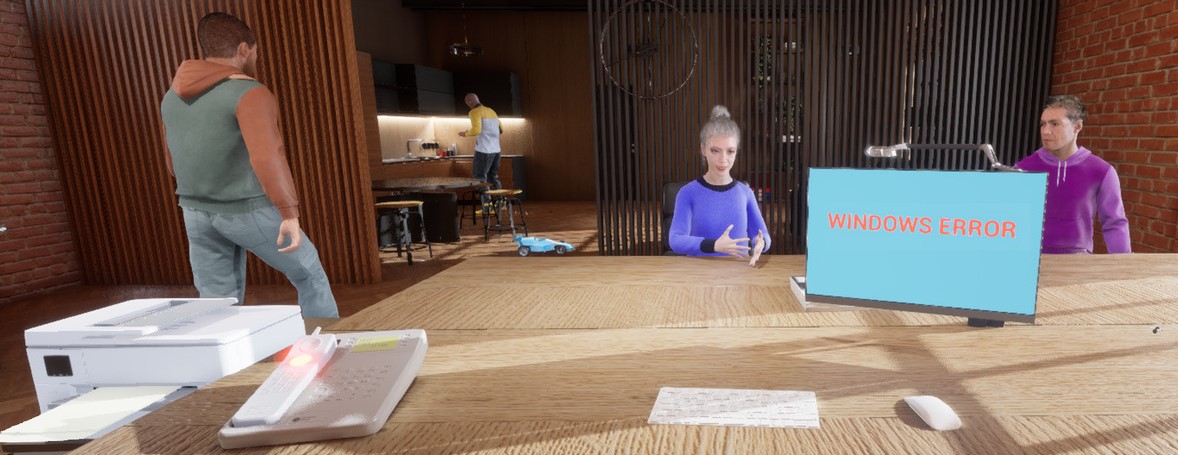
While listening to Embodied Conversational Agents (ECAs) in Virtual Reality (VR), background events can reduce both task performance and comfort. We ran an exploratory study with n = 5 participants who listened to ECA dialogues in a virtual open-plan office while performing a dual - task paradigm (keyword-detection and recall). Distractors varied by sound source (person vs. object) and environmental fit, where congruent distractors (office -specific stimuli, everyday stimuli) fit the virtual workspace, and incongruent distractors (extraordinary stimuli) violated it. Descriptively, distraction and annoyance ratings showed a partial divergence: incongruent distractors were perceived as most distracting, whereas office-congruent object sounds produced the highest annoyance ratings. These preliminary findings suggest that distraction and annoyance may constitute distinct dimensions of user experience.
@inproceedings{10.1145/3821409.3833888,
author = {K{\"u}hlem, Konstantin W. and Welker, Aaron S. and Widera, Agnes and Schlittmeier, Sabine J. and Fels, Janina and B{\"o}nsch, Andrea},
title = {Perceived Distraction and Annoyance in a VR Listening Task},
year = {2026},
isbn = {9798400727993},
publisher = {Association for Computing Machinery},
address = {New York, NY, USA},
url = {https://doi.org/10.1145/3821409.3833888},
doi = {10.1145/3821409.3833888},
booktitle = {Proceedings of the 2026 ACM Symposium on Applied Perception},
articleno = {52},
numpages = {2},
keywords = {distraction, annoyance, attention, virtual reality, user study},
series = {SAP '26}
}
Demo: A Latency-Optimized LLM-based Multimodal Dialogue System for Embodied Conversational Agents in VR

Interactions with Embodied Conversational Agents (ECAs) are essential in many social Virtual Reality (VR) applications, highlighting the growing demand for free-flowing, context-aware conversations supported by low-latency, multimodal ECA responses. We introduce a modular, extensible framework powered by an Large Language Model (LLM), featuring streaming-based optimization techniques specially crafted for multimodal responses. Our system is capable of controlling self-behavior and task execution, in the form of moving through the Immersive Virtual Environment (IVE) directly controlled by the LLM, and is also capable of reacting to events in the IVE. In our study, our applied optimizations achieved a latency improvement of about (66%) on average compared to having no optimizations.
» Show BibTeX
@inproceedings{Kuehlem2025,
author = {W. K\"{u}hlem, Konstantin and Ehret, Jonathan and W. Kuhlen, Torsten and B\"{o}nsch, Andrea},
title = {A Latency-Optimized LLM-based Multimodal Dialogue System for Embodied Conversational Agents in VR},
year = {2025},
isbn = {9798400715082},
publisher = {Association for Computing Machinery},
doi = {10.1145/3717511.3749287},
abstract = {Interactions with Embodied Conversational Agents (ECAs) are essential in many social Virtual Reality (VR) applications, highlighting the growing demand for free-flowing, context-aware conversations supported by low-latency, multimodal ECA responses. We introduce a modular, extensible framework powered by an Large Language Model (LLM), featuring streaming-based optimization techniques specially crafted for multimodal responses. Our system is capable of controlling self-behavior and task execution, in the form of moving through the Immersive Virtual Environment (IVE) directly controlled by the LLM, and is also capable of reacting to events in the IVE. In our study, our applied optimizations achieved a latency improvement of about (66\%) on average compared to having no optimizations.},
booktitle = {Proceedings of the 25th ACM International Conference on Intelligent Virtual Agents},
articleno = {49},
numpages = {3},
series = {IVA '25}
}
Poster: Listening Effort In Populated Audiovisual Scenes Under Plausible Room Acoustic Conditions

Listening effort in real-world environments is shaped by a complex interplay of factors, including time-varying background noise, visual and acoustic cues from both interlocutors and distractors, and the acoustic properties of the surrounding space. However, many studies investigating listening effort neglect both auditory and visual fidelity: static background noise is frequently used to avoid variability, talker visualization often disregards acoustic complexity, and experiments are commonly conducted in free-field environments without spatialized sound or realistic room acoustics. These limitations risk undermining the ecological validity of study outcomes. To address this, we developed an audiovisual virtual reality (VR) framework capable of rendering immersive, realistic scenes that integrate dynamic auditory and visual cues. Background noise included time-varying speech and non-speech sounds (e.g., conversations, appliances, traffic), spatialized in controlled acoustic environments. Participants were immersed in a visually rich VR setting populated with animated virtual agents. Listening effort was assessed using a heard-text-recall paradigm embedded in a dual-task design: participants listened to and remembered short stories told by two embodied conversational agents while simultaneously performing a vibrotactile secondary task. We compared three room acoustic conditions: a free-field environment, a room optimized for reverberation time, and an untreated reverberant room. Preliminary results from 30 participants (15 female; age range: 18–33; M = 25.1, SD = 3.05) indicated that room acoustics significantly affected both listening effort and short-term memory performance, with notable differences between free-field and reverberant conditions. These findings underscore the importance of realistic acoustic environments when investigating listening behavior in immersive audiovisual settings.
