
Profile

|
Agnes Widera, M.Sc. |
Publications
Poster: A Theory -Informed Roadmap Towards Multimodal Ocular-based Attention Metrics for Conversational VR

Eye- tracking in consumer head-mounted displays (HMDs) already provides reliable data for visual attention tracking. We now strive to extend this capability to conversational attention, which also involves auditory processing, cognitive load, mind-wandering, and fatigue. To this end, we propose a taxonomy that maps gaze, blink dynamics, and pupillometry onto these five complementary dimensions and briefly summarize current eye - tracking- based evaluation methods. From the identified gaps, we outline a three - stage research roadmap — (i) robust pupillometry calibration, (ii) multimodal signal disambiguation, and (iii) composite attention-score fusion — aimed at achieving reliable, real -time inference of attentional engagement in Virtual-Reality (VR)-based dialogues.
@inproceedings{10.1145/3821409.3833884,
author = {Widera, Agnes and Kuhlen, Torsten W. and B{\"o}nsch, Andrea},
title = {A Theory-Informed Roadmap Towards Multimodal Ocular-based Attention Metrics for Conversational VR},
year = {2026},
isbn = {9798400727993},
publisher = {Association for Computing Machinery},
address = {New York, NY, USA},
url = {https://doi.org/10.1145/3821409.3833884},
doi = {10.1145/3821409.3833884},
booktitle = {Proceedings of the 2026 ACM Symposium on Applied Perception},
articleno = {36},
numpages = {2},
keywords = {Virtual Reality, Attention, Eye-Tracking, Pupillometry, Blinking},
series = {SAP '26}
}
Poster: Usability of Integrated Eye-Tracking HMDs for Real-Time Unreal Engine Applications
Eye tracking is increasingly employed in VR-based user-experience and interaction research. Although most prior work relies on costly professional or custom- built eye trackers, many contemporary HMDs embed infrared eye trackers, raising the question of whether these built- in systems are mature and sufficiently support real-time research pipelines. We summarize findings from our usability evaluation of four eye-tracking HMDs with Unreal Engine (UE) 5.7. We assess each HMD’s software maturity, engine integration effort, and day-to-day usability, and summarize guidance for researchers selecting eye-tracking hardware for real-time applications.
@inproceedings{Widera2026a,
author = {Widera, Agnes and Kuhlen, Torsten W. and B{\"o}nsch, Andrea},
title = {Usability of Integrated Eye-Tracking HMDs for Real-Time Unreal Engine Applications},
year = {2026},
isbn = {9798400727993},
publisher = {Association for Computing Machinery},
address = {New York, NY, USA},
url = {https://doi.org/10.1145/3821409.3833903},
doi = {10.1145/3821409.3833903},
booktitle = {Proceedings of the 2026 ACM Symposium on Applied Perception},
articleno = {58},
numpages = {2},
keywords = {Virtual Reality, Eye-Tracking, Pupillometry, Blinking},
series = {SAP '26}
}
Poster: Perceived Distraction and Annoyance in a VR Listening Task
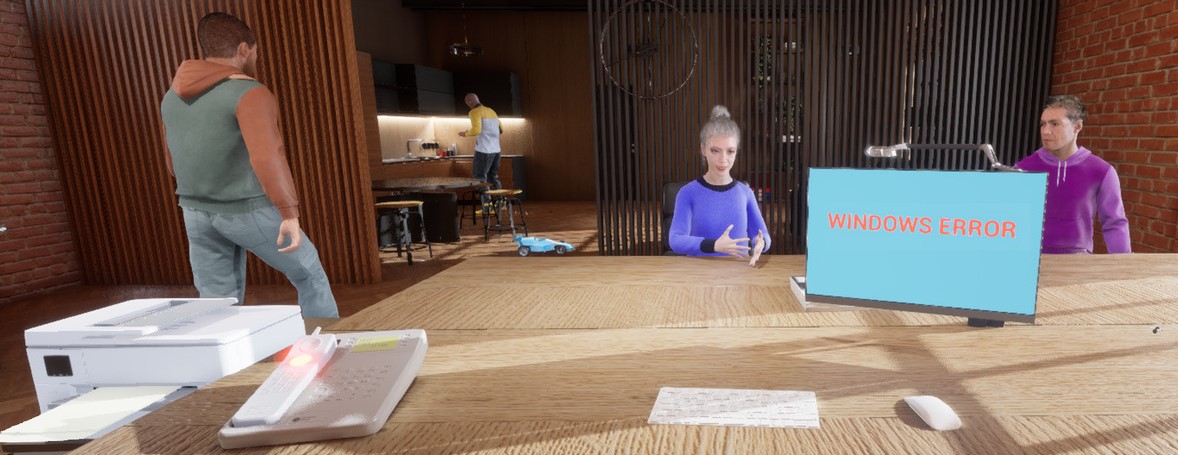
While listening to Embodied Conversational Agents (ECAs) in Virtual Reality (VR), background events can reduce both task performance and comfort. We ran an exploratory study with n = 5 participants who listened to ECA dialogues in a virtual open-plan office while performing a dual - task paradigm (keyword-detection and recall). Distractors varied by sound source (person vs. object) and environmental fit, where congruent distractors (office -specific stimuli, everyday stimuli) fit the virtual workspace, and incongruent distractors (extraordinary stimuli) violated it. Descriptively, distraction and annoyance ratings showed a partial divergence: incongruent distractors were perceived as most distracting, whereas office-congruent object sounds produced the highest annoyance ratings. These preliminary findings suggest that distraction and annoyance may constitute distinct dimensions of user experience.
@inproceedings{10.1145/3821409.3833888,
author = {K{\"u}hlem, Konstantin W. and Welker, Aaron S. and Widera, Agnes and Schlittmeier, Sabine J. and Fels, Janina and B{\"o}nsch, Andrea},
title = {Perceived Distraction and Annoyance in a VR Listening Task},
year = {2026},
isbn = {9798400727993},
publisher = {Association for Computing Machinery},
address = {New York, NY, USA},
url = {https://doi.org/10.1145/3821409.3833888},
doi = {10.1145/3821409.3833888},
booktitle = {Proceedings of the 2026 ACM Symposium on Applied Perception},
articleno = {52},
numpages = {2},
keywords = {distraction, annoyance, attention, virtual reality, user study},
series = {SAP '26}
}
